
Our Programs
Discover the Joy of Learning with Us
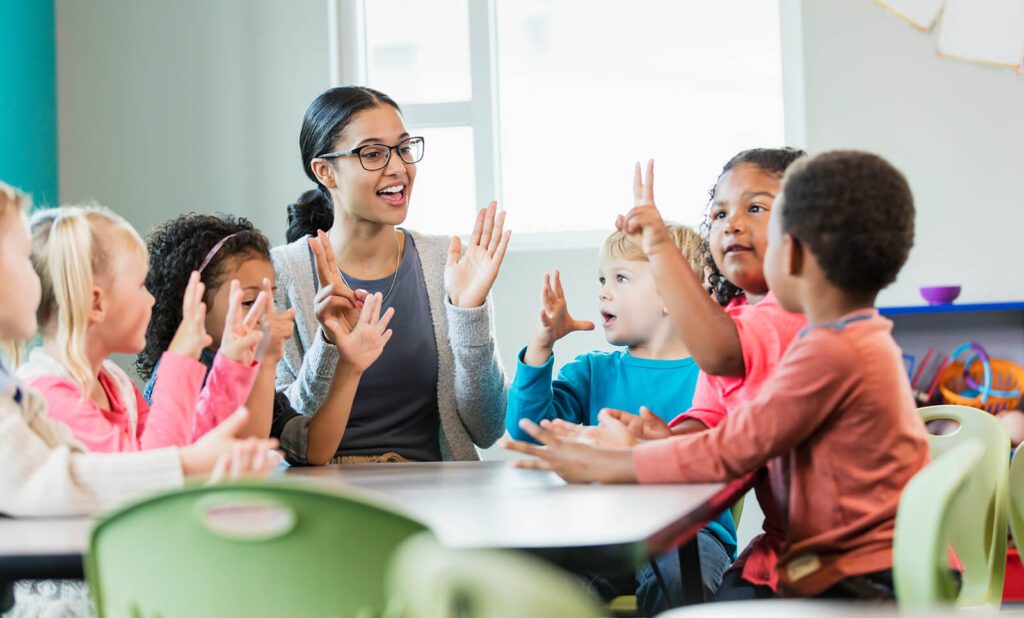

Quakers
Infants 6 weeks-15 months
Our infants are named after the Ivy League school Penn State University! In our infant class, our little Quakers are cared for and provided with a clean, safe, and nurturing environment where they are provided with tons of cuddles and smiles throughout the day. We know all children develop, grow, and learn at their own pace, so we encourage natural curiosity in their classroom environment and we emphasize each child’s individual development journey. We focus on key developmental milestones specific to your infant. In addition, we believe all children can start learning from the time they’re born. Infants have music time, exposure to early literacy and numeracy concepts, and are introduced to at least one foreign language. Our infant program encourages:
- engagement with different textures, sounds, and sights
- exploration of different sounds through objects
- tummy time
- support with motor skills like rolling, crawling, & walking
- interaction with caregivers through songs and stories
- social interaction with others
- communication using non-verbal cues
- recognizing themselves through mirror play
- developing language skills, rhythm, and memory
- trust building and bonding
Pilgrims
Pre-toddlers 16-23 months/1 year olds
Our Pre-toddlers are named after the Ivy League school Harvard University. In our pre-toddler class, our little Pilgrims are engaging with their peers and they learn to share and learn through play. They start their day building connections during circle time where they learn about animals, shapes, colors, the alphabet, number concepts, their body, the world around them, and many other things. They explore different textures while developing fine motor skills. Children are encouraged to express themselves and to demonstrate creativity. They are encouraged to develop a sense of self, and engage in activities that promote a sense of belonging. Our pre-toddler program encourages:
- the enhancement of problem-solving skills
- experiences with their senses
- solving simple puzzles
- building with blocks
- sparking of creativity
- supporting early learning of letters, numbers, and language
- social skills through conversations, cooperation, and sharing
- building friendships

The Beavers
Sophomore toddlers 24-35 months/2 year olds
Our Sophomore toddlers are named after the Ivy League school MIT. In our pre-toddler class, our little Beavers we focus on an integrative, holistic approach. We focus on our 2 year olds’ academic, physical, emotional, and social needs. Children will have the opportunity to explore multiple areas of learning and growing. They learn letter recognition and link letters to sounds as we teach them to begin to read. They use and practice with research-based literacy and numeracy materials that spark their interest, and have multiple opportunities to learn with hands-on resources. In addition, they begin to learn early mathematics concepts such as counting, sorting, and understanding simple addition and subtraction. They are encouraged to develop skills such as kindness, cooperation, courtesy, being helpful, and independence. Our two year old program encourages:
- experience with all their senses
- developing fine and gross motor skills
- being physically active
- learning through observation
- building using natural and man-made materials/resources
- connecting to the world around them
- learning letter names and sounds
- learning beginning numeracy concepts (such as counting in order from 1 through at least 5)
- developing language, learning to speak in simple sentences
- name basic shapes and colors
- engagement with picture books
- exploring the arts
- getting introduced to two foreign languages

Red Bears
Junior Toddlers/younger 3s: 36-41 months/3 year olds
Our Junior-toddlers are named after the Ivy League school Cornell University. In our Junior-toddler class, our little Red Bears are engaged with an even stronger academic and social foundation. Teachers introduce more complex math, literacy, science, and geography concepts. Activities also include music, movement, art, pretend play, and group games. Children become an active part of their classroom community. They also begin to study character education, as they feel a sense of belonging. Our younger three year old program encourages:
- being physically active
- practicing using fine and gross motor skills
- learning emotional regulation
- circle time with calendar, seasons, & weather
- naming letter names & sounds
- naming basic and two-dimensional shapes
- naming basic and more complex colors
- learning beginning numeracy concepts (such as counting in order from 1 through at least 10)
- learning to read basic sight words in isolation
- learning to read basic sight words in books
- learning basic writing concepts (even scribbling)
- enjoy listening to stories
- learn to ask questions about stories
- recognizing environmental print
- complex ideas like opposites
- simple time concepts like yesterday, today, and tomorrow

Brown Bears
Senior Toddlers/older 3s: 42-47 months/3 year olds
Our Senior-toddlers are named after the Ivy League school Brown University. In our Senior-toddler class, our little Brown Bears are engaged with an even stronger academic and social foundation. Teachers introduce more complex math, literacy, science, and geography concepts. Activities also include music, movement, art, pretend play, and group games. Children become an active part of their classroom community. They also begin to study character education, as they feel a sense of belonging. Our older three year old program encourages:
- being physically active
- practicing using fine and gross motor skills
- practicing emotional regulation
- circle time with calendar, seasons, & weather
- naming letter names and sounds
- naming basic and two-dimensional shapes
- naming basic and more complex colors
- learning beginning numeracy concepts (such as counting in order from 1 through at least 15)
- reading basic sight words in isolation
- reading basic sight words in books
- practicing basic writing concepts (even scribbling)
- enjoy listening to stories
- asking and answering questions about a stories
- engaging in conversation about stories with their teacher and peers
- creating sentences with sight words
- using environmental print to create sentences
- learning rhyming words
- manipulating beginning sounds
- complex ideas like opposites
- simple time concepts like yesterday, today, and tomorrow

The Lions
Preschool younger 4s: 48-54 months/4 year olds
Our Preschoolers are named after the Ivy League school Columbia University. In our Preschool class,, our little Lions are preparing to enter the pre-kindergarten class, which is their final year of preschool. Children are encouraged to think independently and express individuality. Their day is filled with creating, experimenting, continuing to build on social skills, and understanding what friendships are. As they prepare, they are exposed to a deeper learning of phonological awareness, phonemic awareness, and the understanding of graphemes.
- moving from learning to understanding the relationship between letters and sounds
- creating sentences with words
- recognizing their first name
- writing their first name
- practicing holding a pencil
- practicing writing sentences (even scribbling)
- ability to look at a picture and provide a description
- beginning to learn phonemic awareness and phonics
- hearing, identifying, and manipulating individual phonemes in spoken words and print
- introduction to encoding and decoding in literacy
- practice with numeracy concepts moving from basic shapes to two & three dimensional shapes
- counting from 1 up through 50
- counting by 1s, 5s, and 10s up to 50

The Tigers
Pre Kindergarten older 4s and 5s: 55 months plus/4-5 year olds
Our Pre-K class is named after the Ivy League school Princeton University. In our Preschool class, our little Lions are in their final year of preschool, as our program is designed to prepare children for kindergarten. There is a strong emphasis on literacy and language arts. The daily routine includes literacy routines, writing, math, science, foreign language instruction, movement, art, and music. Through character education teachers model respect, kindness, and children learn how to resolve conflicts while building friendships. In addition, children learn to express themselves through writing and telling complete stories. Our Pre-Kindergarten program encourages:
- understand the relationship between letters and sounds
- creating sentences with words
- recognizing their first and last name
- writing their first and last name
- learning to hold a pencil
- practicing writing sentences (even scribbling)
- ability to tell what their scribbling reads
- ability to look at pictures to tell a sentence
- engaging in activities that encourage rhyming, word play, and storytelling
- practicing phonemic awareness and phonics
- practicing hearing, identifying, and manipulating individual phonemes in spoken words and print
- practice with literacy fluency, vocabulary, and comprehension
- encoding and decoding in literacy
- practice with numeracy concepts moving from basic shapes to two & three dimensional shapes
- counting from 1 up through 100
- counting by 1s, 5s, and 10s up to 100